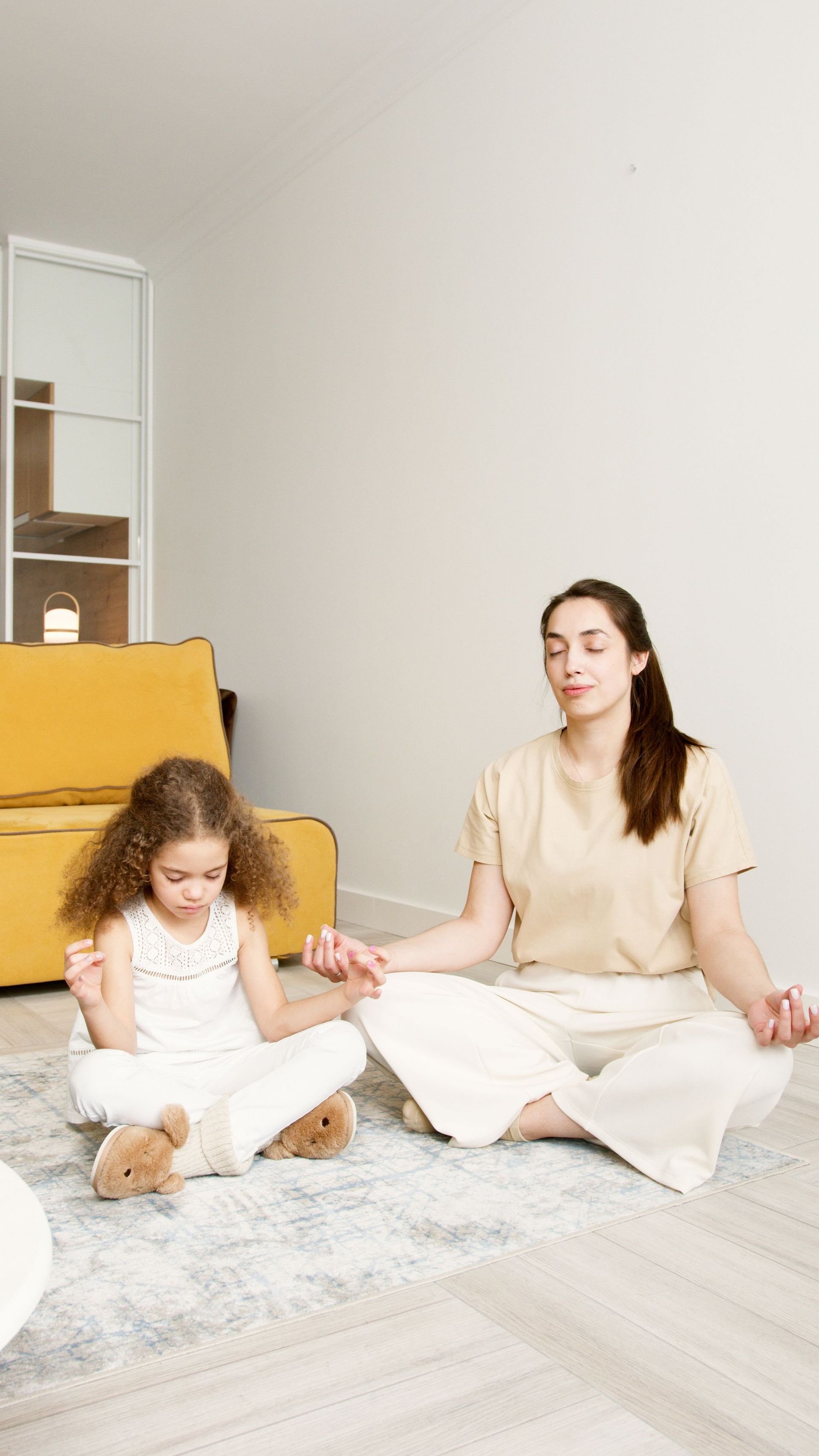
You may be very familiar with mindfulness, or you might view it as a popular buzzword related to meditation. Regardless of your background, incorporating mindfulness into daily routines offers profound developmental benefits for children. Practicing mindfulness helps children and adults alike build self-regulation, improve focus, and cultivate inner peace, and learning together as a family can be a joyful, grounding experience!
What Is Mindfulness?
Merriam-Webster defines mindfulness as:
- The quality or state of being mindful.
- The practice of maintaining a nonjudgmental state of heightened or complete awareness of one’s thoughts, emotions, or experiences on a moment-to-moment basis.
It can also be helpful to define mindfulness by what it is not.
Mindfulness is not about forcing the mind to go completely blank, demanding absolute silence, or eliminating conflict. It is certainly not a quick fix for behavioral challenges. Instead, mindfulness gives us a way to look deeper into our lives. We learn to observe events, physical sensations, and emotions while acknowledging and accepting them without judgment.
In today’s fast-paced world, it is easy for both adults and children to get caught up in the daily rush. Mindfulness allows us to pause, slow down, and remain present. While busy families often wonder how to fit one more practice into their day, forming simple habits of mindfulness often opens up your schedule, helping daily life feel far more flexible, harmonious, and intentional.
Setting Realistic Expectations
Mindfulness is rooted in acceptance. While regular practice often helps children settle and concentrate, it is essential not to approach mindfulness with the rigid expectation of making a child instantly more attentive or quiet. Improved focus and emotional regulation are natural outcomes of the practice, and they develop over time.
It is also natural for children to respond differently to mindfulness activities. Some children jump into guided meditations enthusiastically, while others take time to feel comfortable or prefer movement-based awareness. Honor your child's individual personality and meet them where they are without pressure.
Take a Sensory Journey
In their book Mindfulness: An Eight-Week Plan for Finding Peace in a Frantic World, authors Mark Williams and Danny Penman share a classic exercise that children love: The Raisin Meditation.
To try this activity at home:
- Sit in a quiet, comfortable space with your child.
- Place a single raisin in your child’s open palm, ask them not to eat it yet, and hold one in your own hand.
- Guide your child to use all five senses to observe the raisin slowly and attentively:
- Sight: Look closely at the ridges, valleys, color variations, and the small spot where the raisin is attached to the vine.
- Sound: Hold the raisin to your ear and listen carefully. Children love the playfulness of listening to dried fruit, sharing a giggle as you both confirm its silence!
- Smell: Take gentle breaths inward and notice its aroma. What does it smell like? Describe the scent together.
- Texture: Gently feel the surface with your fingertips. Then, place the raisin on your tongue without chewing, noticing how it feels in your mouth.
- Taste: Finally, chew the raisin slowly. After exploring every detail, the anticipation makes the single bite rich and vibrant!
You can easily adapt this exercise using a chocolate chip, a cucumber slice, a strawberry, or any snack. At mealtimes, taking a moment to appreciate food with all five senses transforms ordinary meals into moments of connection and gratitude.
Simple Mindfulness Games for Families
You can incorporate mindfulness into your home routine through playful daily activities:
- The Object Box: Gather a few similar natural items (pebbles, leaves, shells, or pinecones). Give each participant one minute to study their item closely. Place all items back into a box, mix them up, and see if each person can identify their original object using sight and touch.
- Nature Creature Walk: Walk along a familiar neighborhood path or local park with heightened awareness. Challenge everyone to spot as many tiny living organisms, insects, moss, birds, or fungi, as possible. It is amazing how much beauty we overlook during our daily routines!
- Visual Breath Games: Use bubbles, pinwheels, or a feather to help children visualize their breath. Encourage your child to inhale deeply through their nose and feel the air leave their mouth as they gently blow a bubble or turn a pinwheel.
Supporting Self-Regulation at Rose Hill
In our prepared classrooms at Rose Hill Montessori, mindfulness aligns naturally with our daily routines. Through intentional Practical Life exercises, focused work cycles, and quiet grace and courtesy practices, children develop deep concentration, physical coordination, and emotional awareness.
When we model presence, patience, and nonjudgmental listening, we give our children the tools to navigate their world with resilience and peace.
If you would like to see how our prepared environments foster calm concentration and self-regulation in our Primary and Elementary students, we invite you to
schedule a tour.