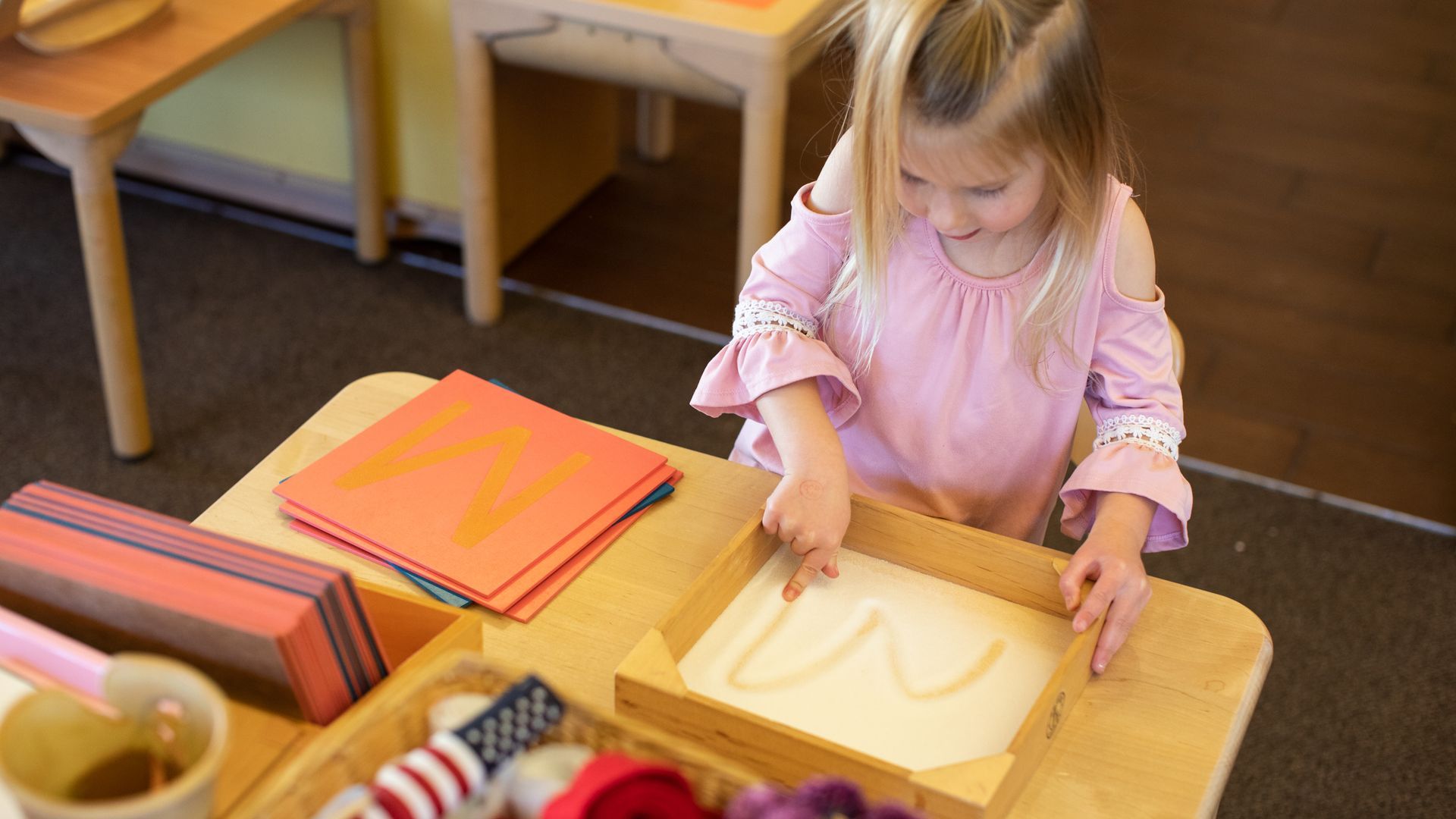
There are key times in children’s lives when they consolidate emerging parts of themselves before stepping into a new phase of growth and change. Two of the most significant transitional milestones occur around age six and again around age twelve, traditionally corresponding to the Kindergarten and 6th-grade years.
Both modern biological science and Montessori theory offer profound insight into why these specific years are so pivotal in a child's development, and why protecting these periods is essential to their long-term confidence and maturity.
The Four Planes of Development
Dr. Maria Montessori observed that a child’s true work is the self-construction of the adult they will become. Adults can support and prepare the environment for this self-construction, but we cannot do the internal work for the child. It happens entirely through their own purposeful activity and interaction with their surroundings.
Through rigorous scientific observation, Dr. Montessori recognized that human development does not occur in a linear, steady slope. Instead, it unfolds in four distinct Planes of Development, each lasting approximately six years:
- First Plane (Ages 0–6): Early Childhood / Infancy – The Absorbent Mind
- Second Plane (Ages 6–12): Childhood / Elementary – The Reasoning Mind
- Third Plane (Ages 12–18): Adolescence – The Social Mind
- Fourth Plane (Ages 18–24): Adulthood / Maturity – The Autonomous Mind
Dr. Montessori noted that the transition from one plane to another is so profound that it often resembles a psychological and physical rebirth. The ages of six and twelve mark the threshold years: around age six, a child steps out of early childhood into elementary; around age twelve, they leave childhood behind to enter adolescence.
Understanding the Biological Shifts
Biologically, significant physical and hormonal shifts take place during these two milestone years. While society broadly understands the biological shifts of young people entering adolescence around age twelve, the profound biological transformation of six-year-olds is less frequently discussed.
Yet the physical signs at age six are undeniable:
- Baby teeth begin to fall out and adult teeth emerge.
- Baby-soft facial features sharpen, and children grow noticeably leaner and longer-limbed.
- Hair texture grows coarser, and physical stamina increases dramatically.
Similarly, our twelve-year-olds stand on the brink of another rapid growth spurt and neurobiological reorganization.
However, a developmental gap can occur between these physical signs of maturity and the underlying cognitive and emotional growth. When children at ages six or twelve are moved prematurely into traditional middle school or kindergarten environments that lack continuity, they are forced to adapt to entirely new systems just as their internal world is shifting.
Without environmental stability, a child must divert precious energy toward navigating new rules, unfamiliar peer groups, and external pressures, energy that should be spent consolidating their intellectual and emotional growth.
Why We Design "Capstone Years"
At Rose Hill Montessori, our multi-age classroom communities (Ages 3–6 in Primary, Ages 6–12 in Elementary) are intentionally structured to honor these pivotal years.
In traditional school settings, Kindergarteners and 6th graders are often pushed into new schedules or viewed as the youngest in a new building. In a Montessori prepared environment, six-year-olds and twelve-year-olds are the capstone leaders of their communities.
Being the oldest in a three or six-year cycle offers unique, irreplaceable advantages:
1. Leadership Built on Security
Because capstone students have spent years in the same environment with the same Guides, they know the routines, expectations, and physical space deeply. They step naturally into leadership roles, mentoring younger peers, giving presentations, and modeling grace and courtesy, without social anxiety or friction.
2. Deep Skill Integration
By teaching and assisting younger classmates, six- and twelve-year-olds reinforce their own knowledge. They look back at work they did years prior and gain a clear, tangible view of how far they have come, building genuine intrinsic confidence.
3. Mastery over Bigger Projects
Capstones carry out multi-step, complex work, whether it’s composing stories with the Moveable Alphabet, managing advanced mathematical fraction operations, or organizing an independent "Going Out" research trip, within a safe, encouraging community that has watched them grow.
The Foundation for Lifelong Confidence
By offering children a stable, secure environment to complete their three-year cycle, we give them the space to consolidate their intellectual skills, emotional resilience, and social self-awareness.
When children complete these capstone years, they do not just move on to the next grade, they transition into the next Plane of Development as grounded, confident, and capable individuals who know who they are.
Experience the Capstone Years in Action
We invite prospective and current families to observe our Primary and Elementary classrooms to witness the leadership, focus, and joy of our capstone students.
Contact us at Rose Hill Montessori School to
schedule a tour.