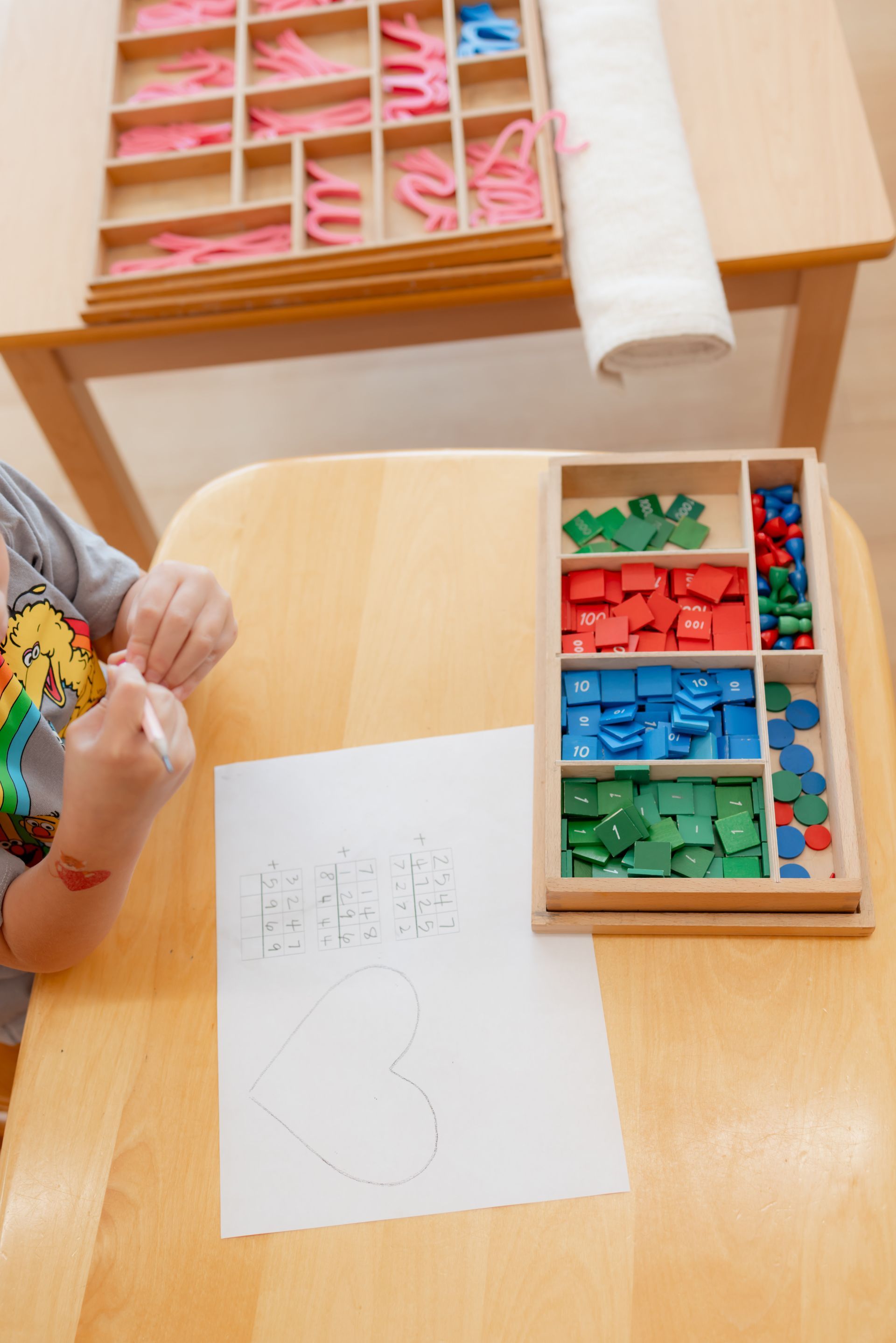
If you peek into the Primary or the Elementary classroom at Rose Hill Montessori, you might spot a child sitting quietly at a table with a small wooden box filled with tiny green, blue, and red tiles. They might be carefully arranging these tiles into long columns, recording multi-digit equations in a notebook, or exchanging ten small blue tiles for a single red one.
They are working with a beloved Montessori math material called The Stamp Game.
Used by children typically between ages 5-8 (depending on their individual developmental readiness), the Stamp Game allows young learners to perform complex addition, subtraction, multiplication, and division problems with numbers well into the thousands.
From Concrete Movement to Mindful Abstract Understanding
Think back to how most of us learned basic arithmetic as children. For many adults, math was introduced abstractly using pencil and paper. We memorized operational rules: “carry the one to the top,” or “borrow from the tens column.” While rote memorization gets the job done, it often teaches children to execute a mechanical process without understanding why the rules exist.
In a Montessori environment, we introduce concepts through concrete, physical manipulation long before asking children to work abstractly.
The Stamp Game serves as a vital bridge between physical bead quantities (the Golden Beads) and abstract paper-and-pencil math. Instead of feeling tedious or intimidating, the Stamp Game makes multi-digit operations an exciting puzzle to solve.
Interestingly, many Montessori alumni report that as adults working with advanced mathematics, they still mentally picture the physical movement and color-coding of these tiny wooden stamps. They carry a permanent, vivid mental model of what numbers are actually doing, not just a memory of memorized rules.
Laying the Foundation
Before a child is introduced to the Stamp Game, their guide (teacher) ensures they have built a solid foundation. Through prior materials like the Golden Beads and Decimal Cards, the child already understands:
- The concept of place value (units, tens, hundreds, thousands).
- The basic operational meaning of addition (combining quantities) and subtraction (taking away).
- Hierarchical color-coding: Green for Units/Ones, Blue for Tens, Red for Hundreds, and Green again for Thousands.
When these foundational concepts are secure, the child is ready for the Stamp Game presentation.
How the Stamp Game Works: Step by Step
Every Montessori presentation is designed with care, intentionality, and respect for the child's independence.
1. Preparing the Work & Introducing the Material
A guide invites a child to receive the lesson. The guide demonstrates how to carefully select the Stamp Game box from the shelf and carry it with two hands to a table. This quiet action models spatial awareness, respect for the environment, and material care.
Upon opening the box, the child explores the contents:
- Wooden Tiles (Stamps): Color-coded and labeled with 1, 10, 100, or 1000.
- Skittles (Wooden Pegs): Used as divisors in division.
- Discs: Used to represent zero in missing place values.
2. Constructing Numbers
The guide writes a multi-digit number (e.g., 3,721) on a slip of paper. The child forms the quantity on their mat using the wooden tiles:
- 1 Green Unit stamp
- 2 Blue Ten stamps
- 7 Red Hundred stamps
- 3 Green Thousand stamps
For some children, forming quantities and associating them with written symbols is the focus of their work for several days. Once this step feels effortless, they move into four-operation work.
Exploring the Four Fundamental Operations
A child may spend a year or more progressing through the complete sequence of operational lessons with the Stamp Game:
Dynamic Addition & Exchanging
Children lay out the stamps for the first addend, place a wooden marker or a ruler, and lay out the second addend below it. To add, they remove the marker and slide all the stamps in each column upward to unite them into a single sum.
When a column reaches 10 or more stamps, the child experiences the concrete reality of "carrying." They gather 10 Unit stamps, place them back in their compartment, and physically exchange them for 1 Blue Ten stamp, reciting: “Ten units equal one ten.”
Subtraction
For subtraction, the child constructs the minuend (the starting amount). They physically remove the quantity required by the subtrahend from each place value column, placing those tiles back in the box to discover the remaining difference.
Multiplication
Children discover that multiplication is simply repeated addition. To solve 1,213 times 3, the child constructs 1,213 three separate times on their mat, unites all the tiles, performs any necessary exchanges, and counts the final product.
Division
Division is presented with delight because it is introduced as the art of fair sharing. Using the wooden skittles to represent people or groups, the child distributes the total dividend tiles equally beneath each skittle. Division is unique as the only operation where children begin with the largest place value (thousands) and work down to the units.
Moving Toward Abstraction
Because children are free to work with the Stamp Game for as long as their developmental needs dictate, they achieve profound computational fluency at their own pace. Periodic observations allow guides to step in with new challenges or offer guidance when a child is ready to transition.
When a child has fully internalised these mathematical concepts through physical manipulation, the Stamp Game has served its purpose. They naturally transition to the next level of abstraction, such as the Small Bead Frame, and eventually move smoothly into abstract pencil-and-paper math with deep confidence, clarity, and joy.
We invite you to come see math in action at Rose Hill Montessori School.
Schedule a tour today!