One of the most inspiring aspects of a Montessori education is that children are introduced to complex, fascinating areas of study very early in their school careers. Science is a perfect example. Walk into any classroom at Rose Hill Montessori School, and you will see students deeply engaged with the natural world.
A major component of our science curriculum, spanning from our Primary classroom straight through our Elementary program, is the study of zoology. Here is a look at the content our students explore and the unique ways they interact with the material.
Starting with the Universe: The Big Picture First
In the Montessori world, we always start with the big, overarching picture before narrowing down to the specifics. This approach provides children with an immediate context and an intellectual "filing cabinet" where they can store the finer details.
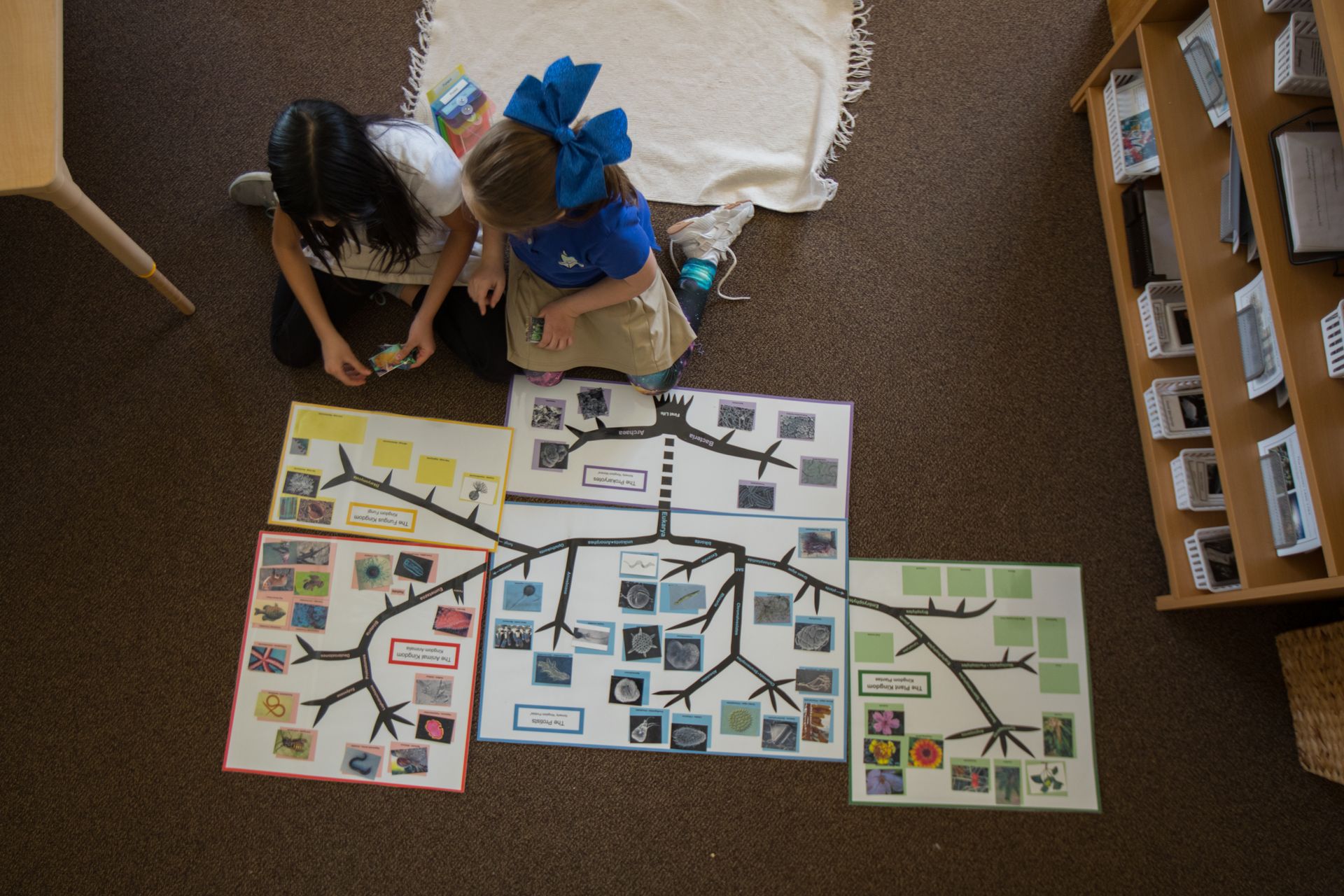
When introducing the living world, we begin at the very top: the
Five Kingdoms of Life.
- Monera (bacteria and single-celled organisms)
- Protista (amoebas and algae)
- Fungi (mushrooms and molds)
- Plants
- Animals
For our youngest children, these initial lessons are beautifully simple, focusing on the major defining characteristics of each kingdom using real-world objects and photographs.
Because our classrooms are multi-age environments, this same material scales beautifully. A younger child might use the kingdom charts to sort photographs, while an older elementary student will return to the very same concept to research cellular structures and evolutionary timelines. Material that grows with the child is a hallmark of the Rose Hill environment.
Categorizing the Animal Kingdom
Once children understand where animals fit into the five kingdoms, they begin to classify the animal kingdom itself. We start with the simplest, most profound division: Vertebrates (animals with a backbone) and Invertebrates (animals without a backbone). Children learn about the incredible evolutionary advantages of having a spine, tracing when these early creatures first emerged on Earth.
From there, students dive into the five major classes of vertebrates:
- Fish
- Amphibians
- Reptiles
- Birds
- Mammals
A Beautifully Layered Curriculum
Because our guides follow the individual child, a six-year-old’s study of reptiles looks entirely different from a nine-year-old’s study of the exact same animal.
- The Primary/Early Elementary Level: A child who is developing their reading skills might learn the external parts of a turtle. They will work with nomenclature to name the head, feet, tail, and shell, discovering specialized terms like plastron (the belly plate), carapace (the upper shell), and bridge (the side connectors). Children love this rich, precise vocabulary; it respects their intelligence and fuels their curiosity.
- The Advanced Elementary Level: Across the room, an older child will study the internal body functions of that same turtle. They will explore how the reptile meets its fundamental needs for survival, investigating its three-chambered heart, its respiratory system, and how its leathery eggs protect its young.
Older students often solidify this knowledge by playing classification games, acting out a scientific version of "Twenty Questions," or launching into deep, independent research projects on creatures that capture their imagination.
The Power of Montessori Three-Part Cards
To support this independent exploration, our environments utilize a specialized material called Three-Part Cards (also known as Nomenclature Cards).
In our Primary classroom, a set consists of a card with a picture, a card with a text label, and a "control card" that features both the picture and the label together. The child matches the picture to the label, and then uses the control card to check their own work.
In our Elementary classrooms, the material evolves. It expands to include a picture, a label, and a detailed definition paragraph, challenging the child's reading comprehension and scientific thinking.
Why Three-Part Cards work: They possess an internal "control of error." This means the material itself tells the child if they made a mistake, completely eliminating the need for an adult to step in and correct them. It fosters pure independence, self-direction, and a deep love for learning.
Connecting Zoology to the Story of Earth
At Rose Hill Montessori, subjects are never taught in isolated bubbles. The study of zoology is intricately woven into our history and geography curriculum through one of our favorite cosmic education materials: The Timeline of Life.
This long, visually stunning chart tells the story of our planet's history. It begins in the Paleozoic era, where simple invertebrates floated through primeval seas, moves through the age of reptiles and birds, and finishes with the emergence of mammals.
When a child learns about an animal in a zoology lesson, they can walk over to the Timeline of Life, find where that creature appeared in history, and visualize exactly how it relates to the rest of the living world. It brings their local point of learning right back to the grand, cosmic picture.
See Our Prepared Environments in Action
The best way to appreciate the depth of a Montessori science curriculum is to watch it unfold in real time. We invite you to reach out and
schedule a campus tour at Rose Hill Montessori School here in Boise, Idaho, to see our students exploring the wonders of the natural world firsthand.